 Loading... Please wait...
Categories
Categories
- Home
- Cake Decorating Tutorials-Recipes - Free
- Rolled Fondant - Recipes & Instructions
Rolled Fondant - Recipes & Instructions
Cake Decorating Instruction
Free Tutorials on cake decorating and how to use your cake decorating supplies.
Rolled Fondant
This icing is rolled out and used as a covering for a firm cake such as pound or fruit cake, which is traditionally first covered with a layer of marzipan to seal in flavor and moistness of the cake. A light layer of buttercream icing or apricot glaze may also be used. Cakes covered with rolled fondant can be decorated with Royal or Buttercream Icing.
How to Color and Flavor
How to Prepare the Cake
Fondant Usage Charts
Covering the Cake
Covering Large Round Cakes
Storage
Helpful Hints
Fondant Rose
Fondant Bows & Loops
Recipes
See Our YouTube Videos on the following:
Fondant Drapes/Swags
Fondant Embossing/Texturing Using Stencils
Fondant Pearls--How To Make
How to Color and Flavor:
The pure white fondant can be easily tinted any color using paste/gel food colors. Add color, a tiny amount at a time and knead into icing until color is evenly blended.
Traditional Rolled Fondant Icing has a mellow flavor which can be enhanced using butter, vanilla, or almond extract.. Knead flavor/extract into icing until well blended.
How to Prepare the Cake
Level cake, position on board cut to fit and fill layers as desired.
For a perfectly smooth fondant cake, the cake surface you cover must be perfectly smooth. Any imperfections on the cake surface will mirror itself on the rolled fondant. Ice cake smooth with a thin layer of buttercream icing, covering all holes and imperfections. Let Buttercream Icing set before covering with Rolled Fondant. One-layer cakes with a very even surface can be coated instead with apricot glaze.
To determine the diameter you need to roll fondant for covering the cake: measure opposite sides and top of cake across center; roll out fondant to that size, 1/4 inch thick. For example, an 8 inch, two-layer cake, with two sides each 4 inches, equals 16 inches diameter. For simple, accurate measuring, roll out the fondant on top of the Cake Dividing Wheel included in the Wilton Cake Dividing Set.
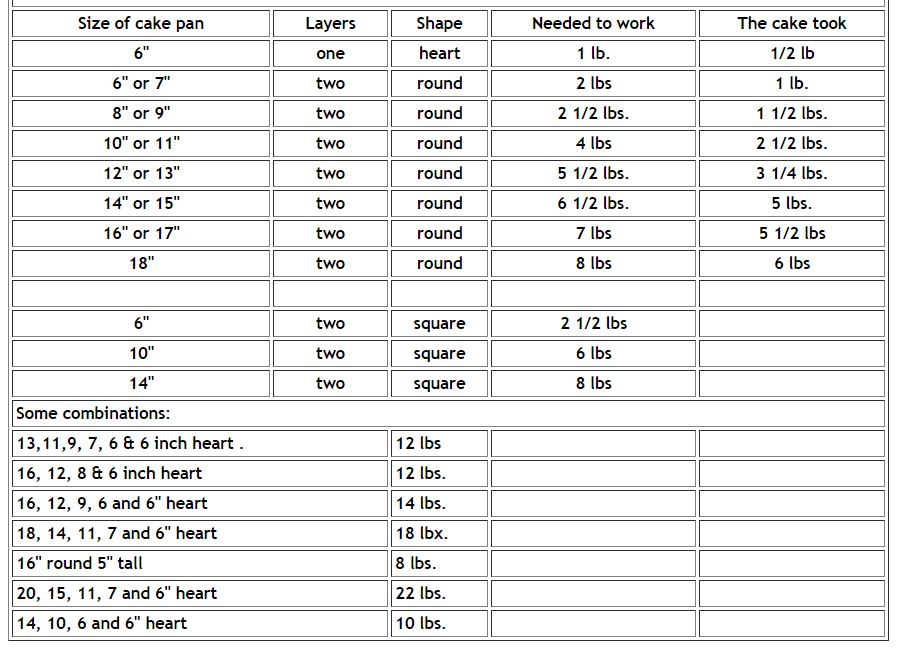
Fondant Usage Chart
Below is a realistic fondant-usage chart created by Earlene Moore. (Used with Earlene's permission.)
This is just a guideline - not a set rule. You must work more fondant than you actually need on the cake to allow enough to hang free to work with for smoothing. The icing on the sides of the layers should be smoothed and gently stretched where necessary to conform to the shape of each individual cake. There should be no folds or creases in the fondant unless that particular effect is desired.
When kneading the fondant we try to figure how much we will need for the whole cake to be sure all of the fondant is the exact same flavor and color. Beginning with the largest cake first and finishing with the smallest cakes allows you to rework the left over trimmings from each cake on the next tier (be sure and remove any crumbs before kneading with other fondant. Buttercream icing will knead into the fondant without any problem.
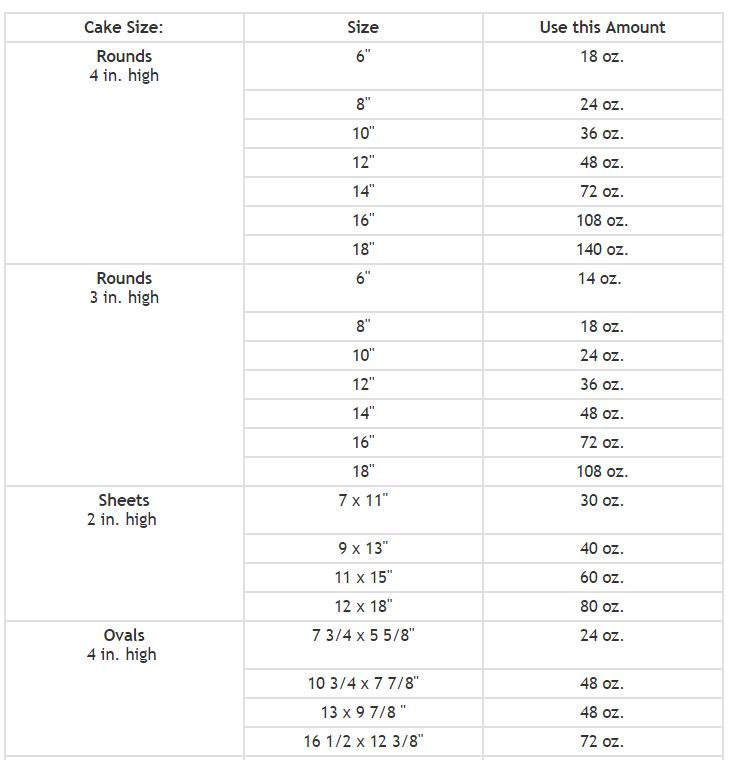
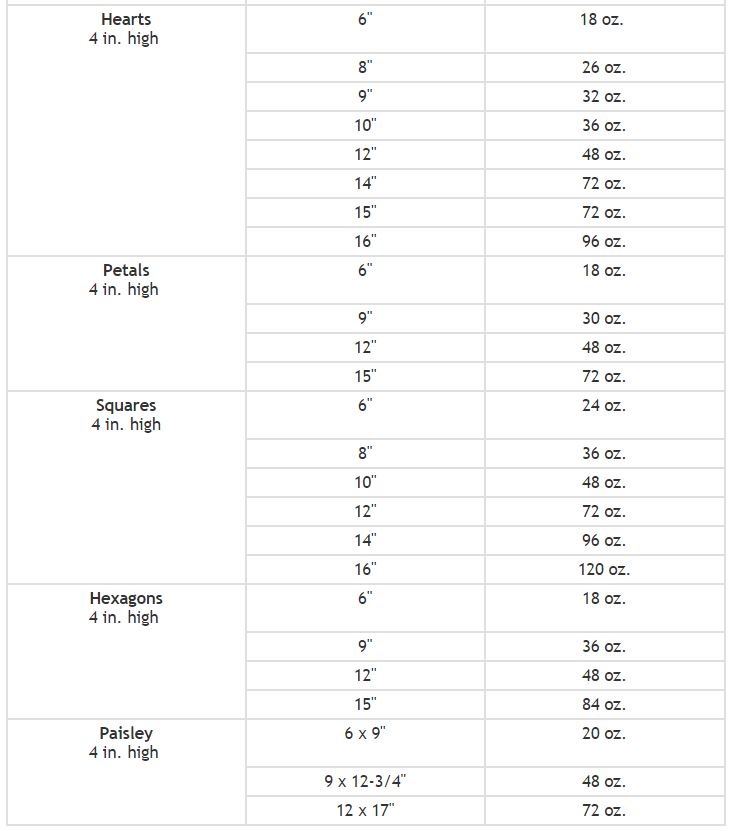
Wilton Fondant Usage Chart
We find these amounts to be too little for rolling out and covering the cake at 3/16-1/4" thickness. The amounts listed are either for thinner fondant or for the amount used just to cover the cake, not including the portion that will be trimmed away (that can then be used to cover another cake).
NOTE: We recommend the following adjustments--for smaller sized cakes, double the amount of fondant listed, for medium sized cakes 1 3/4 times the amount listed, and for larger cakes 1 1/2 times the amount listed.
Amounts listed do not include decorations.
Covering the Cake with Rolled Fondant
How do you cover a cake with fondant that's perfectly smooth, without wrinkles or air bubbles? The flexibility of fondant is your secret weapon. Just follow our instructions for the right ways to knead, roll out and lift the fondant, and you'll find that covering a cake is easy. For instructions on covering Square, Petal and other cake shapes, see the Celebrate® With Fondant book.
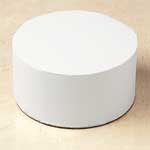
1. Prepare cake by lightly covering with buttercream icing.
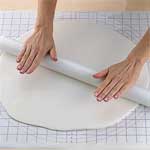
2. Before rolling out fondant, knead it until it is a workable consistency. If fondant is sticky, knead in a little confectioner's sugar. Lightly dust your smooth work surface or the Roll & Cut Mat and your rolling pin with confectioner's sugar to prevent sticking. Roll out fondant sized to your cake. To keep fondant from sticking, lift and move as you roll. Add more confectioner's sugar if needed.
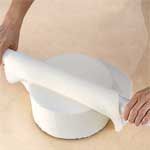
3. Gently lift fondant over rolling pin and position on cake.
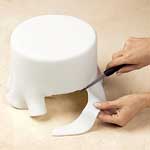
4. Shape fondant to sides of cake with Easy-Glide Smoother. We recommend using the Smoother because the pressure of your hands may leave impressions on the fondant.Use the straight edge of the Smoother to mark fondant at the base of cake. Trim off excess fondant using a spatula or sharp knife.
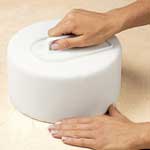
5. Smooth and shape fondant on cake using Easy-Glide Smoother. Beginning in the middle of the cake top, move the Smoother outward and down the sides to smooth and shape fondant to the cake and remove air bubbles. If an air bubble appears, insert a pin on an angle, release air and smooth the area again.
6. Your cake is now ready to decorate.
In most cases, the smaller your cake, the easier it will be to cover with rolled fondant. However, there is an easy way to position and smooth fondant on cakes that are 12 in. diameter or larger. Follow the steps below to lift fondant onto the cake without tearing.
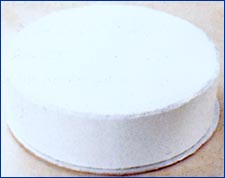
1. Cover cake lightly with buttercream icing. Roll out fondant sized to your cake.
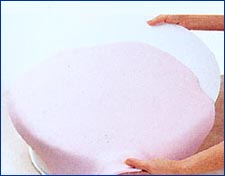
2. Slide a large cake circle that has been dusted with confectioners' sugar under the rolled fondant. Lift the circle and the fondant and position over cake. Gently shake the circle to slide the fondant off the board and into position on the cake. Smooth and trim as described above.
Rounds are easy to cover with fondant. But what about other geometric shaped cakes? On squares or hearts, pull the corner flaps gently out and downward, then smooth to avoid creases. On petals, smooth fondant downward in petal divisions for complete coverage. Cakes made using Wilton shaped pans also look great covered in fondant!
How to Store Fondant-Covered Cake
Iced cake can be stored at room temperature for 2-3 days. Excess fondant can be stored 2 months in an airtight container. Do not refrigerate or freeze.
More Helpful Hints for Fondant
In general, the less height on your cake, the easier it will be to cover with rolled fondant. Individual sized desserts, such as petit fours are the easiest of all to cover.
When rolling fondant, it is extremely important to remember to lift and reposition it several times. You must keep fondant from sticking to your rolling surface or it will tear when you try to lift it up. Dusting the surface with confectioners sugar helps prevent sticking.
Rolled Fondant dries quickly. Always keep it covered to prevent hardening when in use.
--------------------------------------
Fondant Rose
People marvel at the realism of these roses! They also work well in candy clay or marzipan. To make a stem for a single rose, roll a thin log of green fondant and attach.
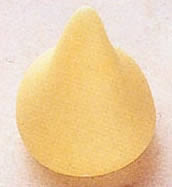
1. Using a 3/4-inch diameter ball of fondant, mold a cone base approximately 1-1/2-inch high.
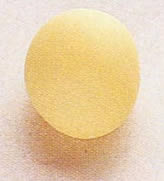
2. Roll a 3/8-inch diameter ball of fondant.
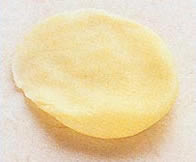
3. Flatten this ball into a circular petal about 1/4 inch thick on bottom and thin on the top. Make about the diameter of a nickel. Make several petals this size.
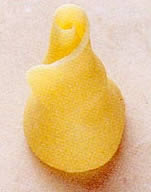
4. Wrap first petal around the point of the cone to form a bud.
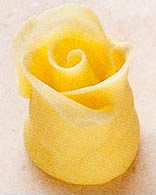
5. Press three more petals around the base of the bud. Gently curl edges of petals.

6. Make five more petals using slightly larger balls of fondant. Flatten, then thin edge with finger and shape petals. Press petals under first row of petals. Continue, placing petals in between and slightly lower than previous row.
Rolled Fondant Bows & Loops
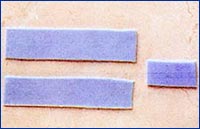
1. Roll fondant 1/8 inch thick. Make a practice bow using these measurements; once you have mastered these steps, modify the measurements for your own cake design: Cut two strips 1 inch wide x 6 inches long for loops and one length 1 inch wide x 2 inches long for center.
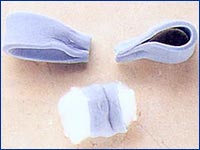
2. Make two loops: Fold strip over to form a loop, aligning ends. Brush ends with a damp brush. Pinch ends slightly to secure. Stand loops upright on side to dry. Make a bow center: Wrap length around your finger to create a loop; brush area to be seamed with a damp brush; overlap the ends slightly and press together to secure. Stand bow center on its side to dry.

3. Insert the ends of two loops into center; secure with dots of icing if necessary and position on cake.
Ready-To-Use Rolled Fondant and Gum Tragacanth:
Use this recipe for a fondant with extra body and pliability ideal for making drapes, swags, woven and elaborate decorations. Decorations will dry like gum paste.
1 to 2 teaspoons gum tragacanth
1 lb. package ready-to-use-Rolled Fondant.
Knead Gum Tex into fondant until smooth. Store in an airtight container or tightly wrapped in plastic.
1 Tablespoon unflavored gelatin
1/4 cup cold water
5 tsp. glycerine
1/4 c. clear corn syrup
1/4 c. glucose
1 Tablespoons solid vegetable shortening
2 lbs. sifted confectioners' sugar
Color and flavor as desired.
Combine gelatin and cold water in saucepan over gental heat. Do NOT boil. Place gelatin mixture in top of double boiler and When gelatin is completely dissolved, remove from heat and add glycerine, corn syrup, glucose, shortening, flavoring, and coloring and stir thoroughly. Add liquid mixture to powdered sugar and mix with hands on a shortening-covered surface until pliable but firm or in a KitchenAid mixer using the dough hook.
Chocolate Rolled Fondant
1 lb. package ready-to-use white Rolled Fondant.
4 oz. premelted unsweetened chocolate product
Knead in 4 oz. of premelted unsweetened chocolate product into the Ready-To-Use White Rolled Fondant until smooth.
*Note: To make a brown colored fondant without the chocolate taste, knead in brown icing color with a small amount of red-red icing color to our Ready-To-Use White Fondant.
Most text and images courtesy of Wilton Industries, Inc. Used with permission
